How to make AI content sound human: 8 edits that work
Learn how to make AI content sound human with 8 practical edits, before and after examples, prompts and a checklist from a UK agency that publishes AI-assisted SEO.

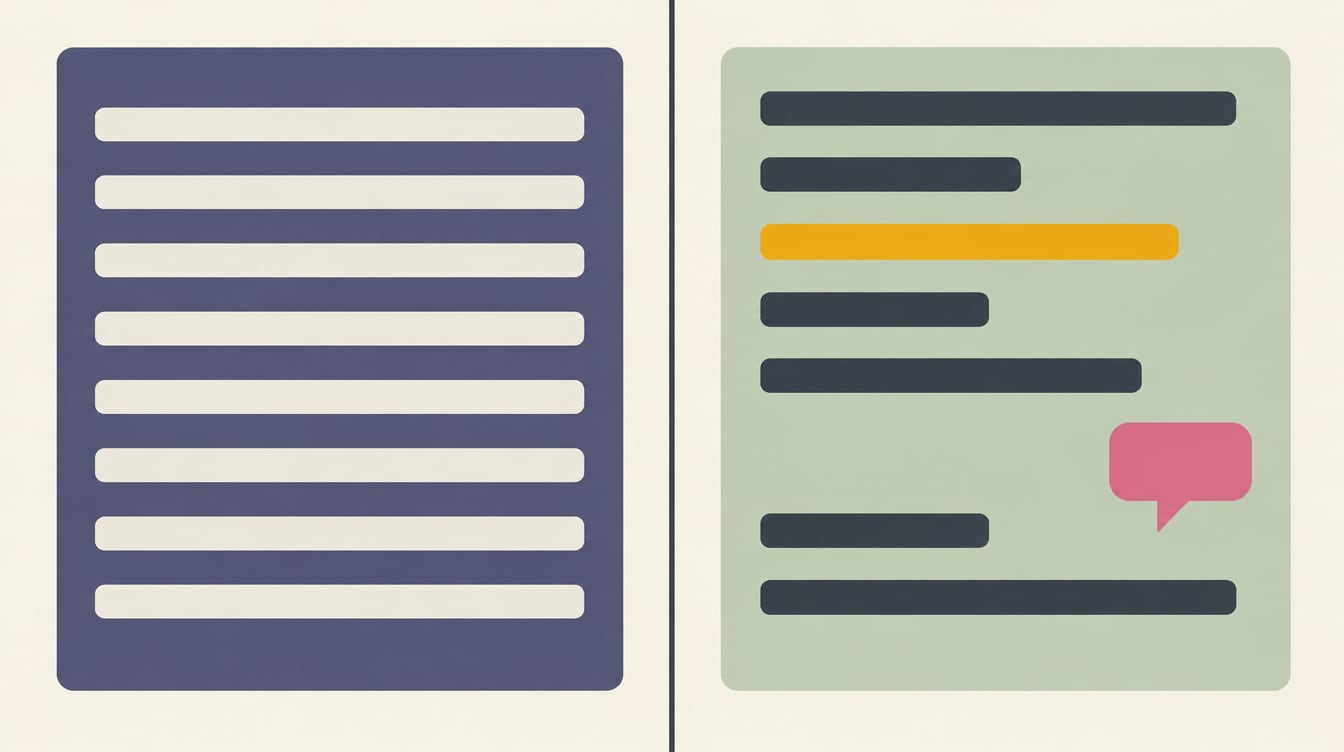
To make AI content sound human, add what only you know: specific examples and your own experience. Then edit out the predictable patterns, such as same-length sentences, stock phrases and tidy groups of three. Swapping words for synonyms does not work. Voice, rhythm and detail do.
At a glance
- AI text tends to show repetitive sentence structure, generic wording, filler and a neutral tone. The usual fixes are varying sentence length, replacing jargon and adding specific examples, as Scribbr’s guide explains.
- One ranking guide recommends four editing passes: cut, add specifics, fix the rhythm, then read aloud and check facts.
- SEO takes three to six months to build, so publishing regularly matters more than one perfect post.
Why does AI content sound like AI?
AI content sounds robotic because the model predicts the safest, most average wording. The result is even sentence lengths, stock phrases, a neutral tone and claims with nothing you can point at.
AI-assisted articles tend to show the same patterns again and again:
- Paragraphs that are all about the same length
- Sentences that march along at the same pace, like fence posts
- Tidy lists of three, even when there are really two points or five
- Filler openers such as “In a fast-paced world”
- Claims with no detail, number, place or example behind them
Readers sense this pattern even if they cannot name it. They feel nobody is really talking to them, and they leave. The good news is that the fixes are simple and you can do them in a single sitting.
What makes AI content sound human?
AI content sounds human when it carries specific knowledge and a clear opinion, with a natural rhythm. The human adds the substance, and an editor removes the predictable patterns.
Substance before style
Before you touch a single sentence, ask what you know that the model cannot. It might be a job you did last month, a question a customer asks every week, or a mistake you see competitors in your trade make. That is the material that makes a piece worth reading.
Why synonym swapping fails
Swapping “important” for “crucial” changes the words and leaves the pattern exactly where it was. The sentences still have the same length and shape, and the same vague claim. Readers notice the pattern, not the vocabulary. Voice and rhythm matter far more than word swaps.
Our view as a UK agency
We have built and looked after websites for UK businesses since 2009, and our view has not changed: real photos and real job stories beat stock content every time. A photo of the actual boiler or the actual shopfront tells a reader something no model can invent.
How do you edit AI text to sound human, step by step?
Edit in passes: cut filler, add specifics, fix the rhythm, add your voice, then read aloud and fact-check. Each pass fixes one thing. That’s faster than rewriting everything. One ranking guide suggests a similar four-pass approach.
- Vary sentence length. Mix short and long.
- Swap stiff phrases for plain ones.
- Cut filler and repeated openers.
- Replace generic claims with details.
- Break uniform patterns.
- Add experience, opinions and real examples.
- Use active voice and add nuance.
- Read aloud and fact-check.
Edit 1: Vary sentence length
AI tends to write sentences of similar length. Break the run.
Before: “Regular maintenance helps your boiler last longer. It also reduces the risk of breakdowns in winter. Many homeowners overlook this important task each year.”
After: “Servicing your boiler helps it last longer. It also cuts the odds of a breakdown in the middle of winter, which is when everyone else’s boiler fails too. Plenty of people skip it.”
The ideas are the same. The second version has a pulse, because a short sentence follows a longer one.
Edit 2: Swap stiff phrases for plain ones
Formal and stock wording is one of the quickest giveaways. Say it the way you would say it to a customer.
| Stiff phrase | Plain version |
|---|---|
| use | use |
| furthermore | also |
| look at | explore |
| in today’s digital landscape | cut it completely |
Edit 3: Cut filler and repeated openers
Look at the first three words of each paragraph. If several start the same way, such as “Additionally” or “It is”, rewrite them. Then delete any sentence that only announces what the next one will say. If a sentence can go, let it go.
Edit 4: Replace generic claims with details you can point at
Before: “Our team has lots of experience building websites for local businesses.”
After: “We have built and looked after websites for UK businesses since 2009.”
The second version gives the reader a fact to hold. A place, a date, a name or a real example does the same job. Only use details that are true. Never add figures you cannot back up.
Edit 5: Break uniform patterns
Not every point needs three bullets. Not every section needs the same number of paragraphs. A list of three that exists only because three sounds neat should be cut to two or expanded to the real number. Let one section run long and another be two lines.
Edit 6: Add experience, opinions and real examples
This is the edit that matters most. Add a sentence that starts with “On a recent job we…” or “Most customers ask us…”, but only where it is true. Add an opinion too. A model plays safe, whereas a person can say “we think this is a waste of money” and explain why. Adobe’s guide makes the same point, suggesting you use AI as a research assistant rather than a writer and add personal experiences.
Edit 7: Use active voice and strong verbs
“The form should be completed by the customer” becomes “The customer fills in the form”. Swap weak verb pairs for single strong ones. Also soften absolutes. “Always” and “never” are rarely true, and a line like “in most cases” or “usually” sounds like someone who has actually done the work.
Edit 8: Read aloud and fact-check every claim
Read the piece out loud. Anywhere you stumble or run out of breath, rewrite. Then check every number, name, date and link, because AI can invent figures with total confidence. If you cannot find a source, remove the claim. Scribbr also lists fact-checking every claim among its tips.
What prompts help AI write more human drafts?
Prompts that give the model your facts, a voice guide and banned phrases produce better first drafts than simply asking it to sound human. “Sound human” means nothing to a model, but “use short sentences and never say ‘look'” does.
Give it source material
Paste in your notes, real customer questions and details of actual jobs. The model can only work with what it has been given, so the more real material you supply, the less it fills gaps with generic filler.
Write a short voice guide
Keep it to a few lines: how long your sentences usually are, how formal you are, and the words you never use. Save it and paste it into every prompt.
Ask it to flag claims
Tell the model to mark any claim that needs a source, so you know where to check.
Copy-ready prompts
- Drafting: “Write about [topic] using only the notes below. Do not add facts, figures or examples that are not in the notes. Notes: [paste].”
- Voice: “Write in plain UK English, warm but professional. Mix short and long sentences. Avoid stock phrases such as ‘in today’s digital landscape’ and ‘look at’.”
- Flagging: “After the draft, list every claim that needs a source or a check, and do not make up any figures.”
- Editing: “Edit this draft. Vary the sentence length, replace formal words with plain ones, remove filler and repeated paragraph openers, and break up any lists of three that feel forced. Do not change the facts.”
Good prompts cut your editing time, though they never replace the human pass. You still need to add the specifics only you know.
Do AI humaniser tools and AI detectors work?
Humaniser tools mostly reword text and can damage meaning, and detectors give unreliable scores. Neither is a substitute for adding real specifics and editing.
Humanisers
These tools generally paraphrase, which is just synonym swapping at speed. Rewording rarely fixes the underlying problem, and it can add awkward phrasing or even errors. This is not a judgement on any one product, only on the general approach. You still need to read the output carefully, so you may as well do the edit yourself.
Detectors
Detectors can give false positives, and universities advise caution before relying on them. Cornell’s Center for Teaching Innovation discusses these limits in its guidance on academic integrity. A score that can wrongly flag a student’s own essay shouldn’t decide how you publish marketing content.
Write for readers instead
A percentage score tells you nothing about whether your article answers the question. Google’s focus is on useful, original content, not on how it was drafted. So spend your time on what readers value. That means clear answers, real examples and facts they can trust.
How do we keep AI-assisted SEO articles human at scale?
At scale, keep articles human by researching what already ranks, building each one around real customer questions and keeping a human approval step you control. This is how we work with our RankOtter product.
Research before writing
Every article is researched from the pages already ranking on Google before a word is written. That means each draft starts from what searchers are actually finding, not from a model’s guess.
Choose your level of control
Some agencies like to read each one, while others check a sample.
Built by an agency that uses it
RankOtter is built by PS Website Design Ltd, a UK web and app development agency that has looked after websites for UK businesses since 2009. We use it on our own clients’ websites.
Habits that protect quality
- Write about the questions your customers actually ask you.
- Never publish near-identical pages for different towns. Google treats them as spam.
- Check your robots.txt is not blocking AI search tools.
- Be patient. SEO takes three to six months to build, so publishing regularly matters more than one perfect post.
Run a trade business? Our page for trades shows how this works for plumbers, electricians and builders.
A checklist before you hit publish
Before publishing, check that the piece has specifics, varied rhythm, plain words, your voice and verified facts. Run through this list every time:
- Is there at least one detail only your business could have written?
- Do sentence lengths vary, with some short ones?
- Have you replaced stiff words like “use” with plain ones?
- Are filler openers and repeated paragraph starts gone?
- Has every generic claim been replaced with something you can point at?
- Did you break up forced lists of three?
- Does it include a real example, opinion or bit of experience?
- Is the voice active, with no absolutes where “usually” is truer?
- Did you read it aloud and fix every stumble?
- Are every number, name and link checked?
Would you like a hand keeping AI-assisted articles sounding like you? See our plans or get in touch with Rank Otter. We will analyse your website free and write your first article on us.
Frequently asked questions
How can I make ChatGPT sound human for free?
Give it your own notes, a short voice guide and a list of phrases to avoid, then edit the draft yourself. Add real examples, vary sentence length and read it aloud. It costs nothing but your time.
Is there an AI that makes text sound more human?
Some tools claim to, but most only reword text, which does not fix rhythm or add substance.
Does Google penalise AI-generated content?
Google’s focus is on whether content is useful and original, not on how it was drafted. Thin, generic pages are the risk. Articles with real detail and checked facts are in a much better position.
How long should I spend editing an AI draft?
It depends on the draft and how much of your own knowledge it needs. Work in short passes, one edit at a time, and stop when the checklist is clear. Good source material and prompts cut the time.
Can AI detectors tell if my content is AI?
Not reliably. Detectors can wrongly flag human writing, and universities advise caution before relying on them. Treat a score as a rough hint at best, and focus on whether the piece helps your reader.
What words should I remove from AI writing?
Cut stiff and stock phrases such as “use”, “furthermore”, “look at” and “in today’s digital landscape”. Replace them with plain words like “use”, “also” and “explore”, or just delete them.
Should I tell readers an article used AI?
Whether to say so is your call, and some sectors and clients expect openness. Whatever you choose, take responsibility for the content. Check every fact and make sure the article carries your own knowledge.