Local blog topics for tradespeople: 15 ideas that win work
Plumber, electrician, builder or roofer? Get 15 local blog topics for tradespeople, with the local trigger for each and how to publish them without spam.


The best local blog topics for tradespeople answer the questions customers ask before they call: what a job costs, signs something needs fixing, local planning rules, seasonal problems and real jobs you have finished nearby. Each post should name the area, show your own photos and point to one clear enquiry action.
A local blog topic for tradespeople is a subject tied to a place and a customer question, such as a nearby job or local housing issue. It helps a trade business show up in local searches.
At a glance
- SEO usually takes three to six months to build, so regular publishing matters more than one perfect post.
- Near-identical pages for different towns are treated by Google as spam, so each local post needs its own genuine detail.
- Planning-application listings show real local demand: one Denton page counted 36 applications in 90 days, naming extensions, dormers and garage conversions.
- AI tools such as ChatGPT and Google AI Overviews are now part of how people find local tradespeople, so robots.txt should not block AI search tools.
- Council regeneration plans, such as the Destination Denton scheme with a £16.8 million funding figure, can inspire local property and building topics.
What are the best local blog topics for tradespeople?
The best local blog topics for tradespeople are customer questions, cost guides, warning signs, seasonal checks, local rules and real job stories, each naming the area you cover. Generic trade advice is everywhere. A post about damp in 1930s semis in your own patch matches what a nearby homeowner actually types into Google.
- What a rewire costs in your area
- What a boiler replacement costs locally
- What an extension costs locally
- Common repairs in Victorian terraces
- Common repairs in 1930s semis
- Snagging and fixes in new builds
- Signs a roof needs urgent attention
- Signs an old consumer unit needs replacing
- Winter pipe and boiler checks
- Spring and summer projects such as loft conversions and EV chargers
- Autumn gutter, heating and draught checks
- Planning permission versus permitted development in your council area
- How a local regeneration scheme affects homeowners
- A real job write-up with photos
- A frequently asked questions round-up from your calls and quotes
Topics matched to a local trigger and trade
| Topic | Local trigger | Trades it suits |
|---|---|---|
| Cost guide for a job | Questions on calls and quotes | Plumber, electrician, builder, heating engineer |
| Repairs in local housing stock | Typical homes on your patch | Plumber, electrician, builder, roofer |
| Urgent warning signs | Storm damage, old wiring, failing boilers | Roofer, electrician, heating engineer |
| Seasonal checks | Local weather | Plumber, roofer, heating engineer |
| Planning and permitted development | Council planning portal | Builder, roofer |
| Regeneration schemes | Council announcements | Builder, electrician |
| Real job story | A recent nearby job | All trades |
Many of the pages that rank for this search are sales pages for SEO services. They rarely give you an actual list of topics, and they seldom tie each idea to a trigger you can check yourself. This article aims to do both.
What local blog topics answer customer questions?
Questions customers ask you on calls and quotes are the safest local blog topics, because they match real searches and show your expertise. If three people ask the same thing in a month, others are typing it into Google.
Cost guides with a local angle
Write about what a rewire, a boiler replacement or an extension involves in your area. Explain what changes the price: house size, access, the state of existing pipework or wiring, and materials. Where you have no firm figure, say what the cost depends on. Don’t guess.
Housing stock topics
Think about the homes you visit most. Victorian terraces, 1930s semis and newer estates each have their own habits. Cover the common repairs, what a homeowner can reasonably check and when to call a professional.
Urgent warning signs
Posts on roof damage or scorching around sockets get read by people who are worried and ready to act. The same goes for an ageing consumer unit (the box that holds your home’s fuses or circuit breakers). Be plain about which signs mean stop and call someone.
How to collect the questions
Keep a simple log of questions from phone calls and WhatsApp messages, and from quotes. Write down the wording customers use. Then plan each answer first: put the direct answer in the opening sentences, and add detail underneath.
What seasonal blog topics should plumbers, electricians and roofers write?
Seasonal posts work because demand spikes predictably. Tie each one to a UK season and a local problem, and publish a few weeks before the problem hits.
| Month | Topic | Trade |
|---|---|---|
| October | Boiler service before the cold snap | Heating engineer |
| November | Gutter clearing and draught-proofing | Roofer, builder |
| December to January | Frozen pipes and what to do | Plumber |
| February | Storm roof checks | Roofer |
| March to April | Planning an extension for summer | Builder |
| May to June | EV charger installs and outdoor electrics | Electrician |
| July to August | Loft conversions while the weather is dry | Builder, roofer |
Add the local angle
Generic advice such as “lag your pipes” is easy to find. Add what is specific to you: the older terraces with north-facing walls, the exposed roads where storms hit hardest, or the estates with loft spaces that suit conversion. That detail is what makes the post yours.
What local planning and property topics can builders write about?
Local planning activity and regeneration plans show where demand is heading and give builders specific topics to write about. Your council publishes much of this for free.
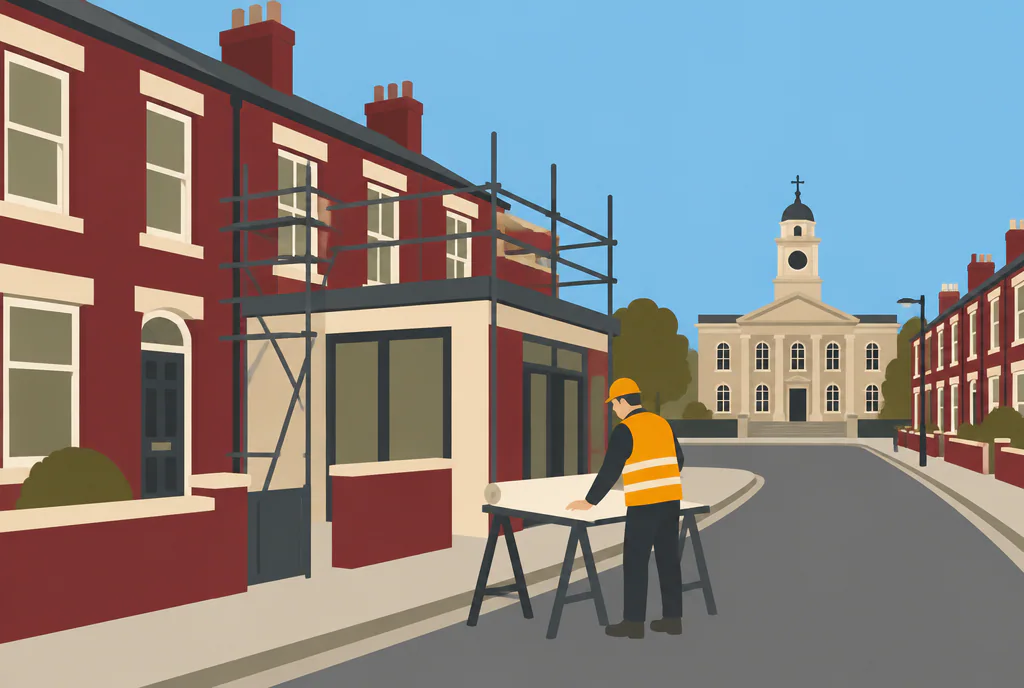
Planning permission and permitted development
Explain when an extension, dormer or garage conversion may need planning permission and when it may fall under permitted development (rights that allow some work without a full application). Frame it around your own council area. Always link to the official council page rather than guessing the rules, and tell readers to check the current position, because rules change.
Use planning data as a topic source
Your council’s planning portal shows what neighbours are applying for. Listings elsewhere show how useful this can be: a Denton listing counted 36 applications in 90 days, naming extensions, dormers and garage conversions. If you quote any figure from your own portal, give the source and the date you checked it.
Regeneration and housing schemes
Larger schemes create questions for homeowners nearby. The Destination Denton scheme from Tameside Council carries a £16.8 million funding figure, for example. A builder in that area could write about what regeneration might mean for property upgrades, sticking to what the council has published.
How do real jobs and photos make local posts rank?
Real job stories with your own photos beat stock content because they prove the work, name the place and cannot be copied. Readers trust a before-and-after from a street they know far more than a polished stock image.
A simple job write-up structure
- The problem the customer had
- The street or area (not the full address unless the customer agrees)
- What you did
- How long it took
- The result
Photos and extras
- Use your own photos with descriptive file names, such as replacement-consumer-unit-leeds.jpg, and short alt text that says what the image shows.
- Add a customer quote only if it is genuine and you have their permission.
- Finish with one clear action and your contact details.
- Link the post to the relevant service page so readers can move from story to enquiry.
How do you publish local blogs without being flagged as spam?
Never publish near-identical pages for different towns. Write each post around a distinct question, job or local fact, and publish steadily. Swapping a town name into one template looks thin and repetitive, and Google treats it as spam.
Consistency beats perfection
SEO usually takes three to six months to build, so publishing regularly matters more than one perfect post. A realistic rhythm you can keep up for months is worth more than a burst of ten posts followed by silence.
Let AI search tools in
People now find local tradespeople through tools such as ChatGPT and Google AI Overviews, as PodDigital notes in its guide to SEO for tradesmen. Check that your robots.txt file (the file that tells crawlers what they may read) is not blocking AI search tools.
Automating the routine
If writing is what stalls you, Rank Otter for trades can help. Every article is researched from the pages already ranking on Google before a word is written, then written and published to your site. You can approve each article or choose full autopilot, and results come from your own Google Search Console. Rank Otter is built by PS Website Design Ltd, a UK web and app agency that has built and looked after websites since 2009, and used on its own clients’ websites. Your first article is free, with no card needed.
To see how it would work for your trade, get in touch with Rank Otter and we will talk you through it.
Frequently asked questions
How often should a tradesperson blog?
A tradesperson should blog as often as they can keep up for at least three to six months. SEO takes that long to build, so a steady rhythm matters more than a flurry of posts.
How long should a local blog post for a trade business be?
A local blog post should be as long as it takes to answer the question fully, and no longer. A short cost guide may need less than a job write-up with photos. Lead with the answer, then add detail.
Do blogs really get tradespeople more enquiries?
Blogs can bring more enquiries by putting your business in front of people searching for the questions you answer. Results take time, usually three to six months, and depend on publishing regularly with real local detail.
Should I write a separate post for every town I cover?
No, not unless each post has its own genuine content. Google treats near-identical town pages as spam. Instead, write about a distinct job, question or local fact in each area.
What should a plumber blog about?
A plumber should blog about boiler replacement costs, frozen pipes in winter, leaks common in local housing, and real jobs completed nearby. Base each post on a question customers have actually asked you.
Can I use AI to write my trade blog posts?
Yes, AI can help with drafting, but the post still needs your own local detail and job stories, along with your photos. Review everything for accuracy, particularly planning rules and costs, before it goes live.
How do I add local detail if I have no photos yet?
Start taking photos on your next job, with the customer’s permission. Until then, write about local housing types, council planning information and seasonal problems, linking to official sources, and add job stories as your photo library grows.