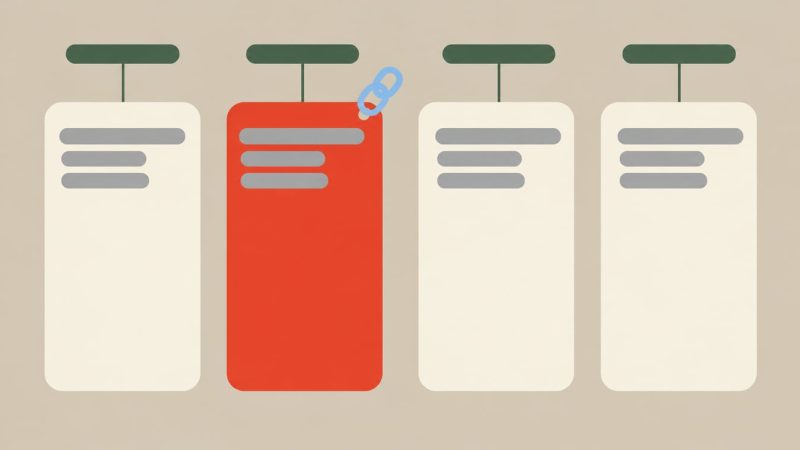
Answer first content structure: how to write it
Learn how to build an answer first content structure: lead each section with a direct 40 to 60 word answer, then add detail, proof and next steps.


An answer first content structure puts the direct answer at the top of the page and at the start of every section, in roughly 40 to 60 words, before any background. Headings are phrased as real questions, and supporting detail, evidence and next steps follow, so readers, Google and AI search tools can quote it.
At a glance
- A direct-answer block is typically 40 to 60 words, placed straight after a heading that asks the question.
- The advice from ranking guides is to state the answer in the first one or two sentences of each section, with no warm-up.
- SEO usually takes three to six months to build, so regular publishing matters more than one perfect post.
- Rank Otter researches every article from the pages already ranking on Google before writing.
- Rank Otter’s first article is free with no card needed, and plans start at £29 + VAT a month for 30 articles.
What is an answer first content structure?
It means the answer comes before the context. You give it in the page intro and again under every heading, so a reader or an AI tool gets the point straight away.
The old build-up style works the other way round. It opens with a line about how important the topic is and adds some history. The answer only turns up a few paragraphs down. Plenty of readers never get that far.
An answer first page is made of a few simple pieces:
- A heading phrased as a question
- A direct answer block of 40 to 60 words
- Supporting detail that explains the answer
- Proof, such as an example, a photo or a real job
- A next step the reader can take
None of this is a separate trick. It is ordinary good SEO, written so the useful part is easy to find. If you are also reading about AEO (answer engine optimisation), GEO (generative engine optimisation) or AI Overviews, this is the writing habit behind most of that advice.
Why does answer first content get cited by AI and Google?
AI tools and search features tend to pull short, self-contained passages. A clear answer sitting directly under a question heading is easy to lift and quote, so it gives them less work to do.
What makes a passage easy to extract?
A passage that makes sense on its own does best. If the answer depends on three earlier paragraphs, a tool cannot use it cleanly. Plain titles that say what the page covers also help matching, because the page and the search use the same words.
Does structure guarantee a citation?
No. Good structure raises the chance of being quoted, but nothing guarantees it. Authority, relevance and competition still count, and no one outside the search engines controls the final choice.
Check robots.txt before anything else
This is the technical check ranking pages skip. Open yourdomain.co.uk/robots.txt and make sure it is not blocking AI search tools. A beautifully structured article cannot be quoted by a crawler that was told to stay out. Check your headings too: one question per heading, in a sensible order, with no skipped levels.
How do you write a direct answer block?
Write 40 to 60 words straight after the heading, using the question’s own key words, with one clear claim and no preamble. Expand only after the answer is down.
- Pick one question a customer would really ask.
- Answer it plainly in one or two sentences, using the words of the question.
- Add the number, range or steps if the question needs them.
- Trim until the block sits at roughly 40 to 60 words.
- Read it alone. If it only makes sense with the paragraphs around it, rewrite it.
- Then add detail, proof and a next step below it.
A before and after example
Before (under the heading “How long does a boiler service take?”):
“Boilers are one of the most important parts of any home, and keeping them in good order is something every homeowner should think about. There are many factors involved, and every property is a little different, so it is hard to say for certain.”
After:
“A standard boiler service usually takes about an hour, though older boilers or ones with faults can take longer. The engineer checks the main parts, tests for safe operation and tells you about any repairs needed. Access matters too. Allow a little extra time if the boiler is awkward to reach.”
The second version gives a number, a reason it can change and a hint of what comes next. The first gives nothing a reader can use. Treat the boiler figures here as an illustration of style, and use your own real timings in your own copy.
What is the best answer first template for a blog post?
Use a question title, a direct answer, a key facts box, question headings that each open with an answer block, then an FAQ and a practical next step. The layout below suits a post of about 1,400 words.
| Part | What goes in it | Approx. words |
|---|---|---|
| Opening answer | Direct answer using the main keyword | 40 to 60 |
| Key facts box | 4 to 5 short facts | 60 to 90 |
| Sections (5 to 7) | Question heading, answer block, detail, proof | 150 to 200 each |
| Next step | Short call to action in the last section | 30 to 50 |
| FAQ | 5 to 7 short questions and answers | 150 to 250 |
Six sections at around 160 words each come to roughly 960 words. Add the opening, the box and the FAQ and you land close to 1,400.
Match the format to the answer. A table suits comparisons and costs, a numbered list suits a process the reader follows, and plain paragraphs suit everything else. Do not force bullets into an answer that reads better as a sentence.
How do you choose the questions to use as headings?
Start with the questions your customers actually ask you, then check People Also Ask and the pages already ranking to find what they miss.

Sales calls, emails and enquiry forms are the best source. If three people asked the same thing this month, that is a heading. Then look at the pages ranking for it. Note what they cover and what they skip. Spot where they ramble, and write the section that fills the gap.
This is how we work at Rank Otter: every article is researched from the pages already ranking on Google before a word is written.
Add proof that stock content cannot match
Real photos and real job stories beat stock content every time. A short account of something you actually did gives a reader a reason to trust the answer above it.
Avoid near-identical town pages
Never publish near-identical pages for different towns with only the place name swapped. Google treats them as spam. If you work in several areas, write about real jobs and real questions from each one instead.
How can you apply answer first structure across many articles?
Work from a repeatable brief and publish regularly. Results take three to six months to build, so steady output matters more than one perfect post.
For agencies, that means standardising the brief so every writer follows the same pattern: question heading, answer block, detail, proof, next step. Check each draft against the template before it goes live.
We built Rank Otter to do this for you. We research from the ranking pages, then write and publish straight to your site. You choose the control you want, from approving every article to full autopilot. Our features page shows how it fits together.
Measure with your own Google Search Console data rather than estimates. It shows which questions bring impressions and clicks, and which sections need a sharper answer.
Plans are priced in articles a month, not credits or words:
| Plan | Price | Articles a month | Sites |
|---|---|---|---|
| Growth | £29 + VAT a month | 30 | 1 |
| Pro | £79 + VAT a month | 75 | 3 |
| Agency | £199 + VAT a month | 200 | 10 client sites |
Rank Otter is built by PS Website Design Ltd, a UK web and app development agency that has built and looked after websites for UK businesses since 2009. We use it on our own clients’ websites. Your first article is free with no card needed, and there is a 30-day money-back guarantee on your first payment. See the pricing page for details, or contact us to try a first article on your own site.
Frequently asked questions
How long should an answer first paragraph be?
Aim for roughly 40 to 60 words. That is long enough to give a complete answer and short enough to quote whole.
Does answer first structure work for Google rankings as well as AI?
Yes. Clear headings and direct answers help readers find what they need, which is what Google wants to reward. It supports ranking but does not guarantee it.
Should the answer go before or after the introduction?
Before. Make the answer your introduction, and put any background after it.
Is answer first content the same as AEO or GEO?
Not exactly. AEO and GEO are wider approaches to being cited by answer engines and AI tools. Answer first writing is one practical habit within them.
Can I use answer first structure on old blog posts?
Yes. Rewrite the opening and the first lines under each heading, turn vague headings into questions and keep the useful detail you already have.
How many questions should one article answer?
Five to seven main questions suit a post of about 1,400 words, plus a short FAQ for related points.
Does answer first writing make articles too short?
No. The answer is short, but the detail, proof and next steps that follow keep the article full. It simply puts the useful part first.