How to rank in AI Mode: a practical UK guide
Learn how to rank in Google AI Mode: be indexed and crawlable, publish unique useful content, match structured data and measure results in Search Console.


To rank in AI Mode, make sure Google can crawl and index your pages, then publish unique, genuinely useful content that answers specific questions better than competing sites. Keep structured data matching visible text, and measure results in Search Console. Google says normal SEO practice is the foundation for AI Mode.
Google AI Mode is a generative search experience that uses AI to pull information from Google’s index and write a conversational answer, linking to the pages it draws on.
At a glance
- Google published a dedicated guide to optimising for generative AI search in May 2026, and says core SEO practices still apply. (Google Search Central)
- To appear in AI features, a page must be indexed and eligible to show in Google Search. There are no special extra requirements.
- Structured data should match the visible content on the page.
- Preview controls let site owners manage how their content appears in AI features.
- SEO typically takes three to six months to build, so regular publishing matters more than one perfect post.
What is Google AI Mode and how does it choose pages?
AI Mode is Google’s conversational search experience that retrieves relevant pages from its index and writes a summarised answer with links. The pages it links to come from the same index that powers ordinary search results.
In plain terms, Google finds pages that look useful for the question, reads them and pulls the answer together in a chat-style reply. AI Overviews are the shorter AI summaries that sit at the top of normal results. The longer back-and-forth, where people can ask follow-up questions, is a separate thing called AI Mode.
Being indexed is the entry ticket. If Google has not stored your page, it cannot be used in an answer. Google’s guidance on AI features and your website says a page needs to be indexed and eligible to show in Search, with no special extra requirements.
Updated November 2026. Google published its dedicated guide to optimising for generative AI search in May 2026, and this article builds on it.
Is SEO still relevant for ranking in AI Mode?
Yes. Google says established SEO practice is the foundation for appearing in AI search, with no separate secret tactics required. Its May 2026 resource on optimising for generative AI keeps the focus on the basics: crawlable pages, helpful content and a good experience for visitors.
Myths to drop
- You do not need special markup to appear in AI Mode.
- An AI-only file on your site isn’t needed.
- Rewriting every page in a new style for AI isn’t needed either.
Traditional rankings still matter alongside citations. The same strengths that help a page rank, such as clear answers, trustworthy detail and a sound site, also make it a good candidate to be linked in an AI answer.
How do you rank in AI Mode step by step?
Follow five steps: make pages crawlable, write unique useful content, answer real questions, keep structured data accurate and show real expertise.
- Make pages crawlable and indexed. Check that Google can reach each page and that nothing tells it to stay away.
- Write unique, useful content. Give readers something they cannot get from the next result, written for people first.
- Answer real questions. Write about the questions your customers actually ask you, in the plain words they use.
- Keep structured data accurate. Any markup should match what a visitor can see on the page.
- Show real expertise. Real photos and real job stories beat stock content every time.
Publish regularly. SEO takes three to six months to build, so steady publishing matters more than one perfect post. Avoid the shortcut of near-identical pages for different towns, because Google treats them as spam. One strong page per genuine topic or service is better.
What technical requirements apply to AI Mode?
Pages must be crawlable, indexable and eligible for a Search snippet, with fast, usable pages and structured data that matches visible text. Nothing here is new, but each point is worth checking.
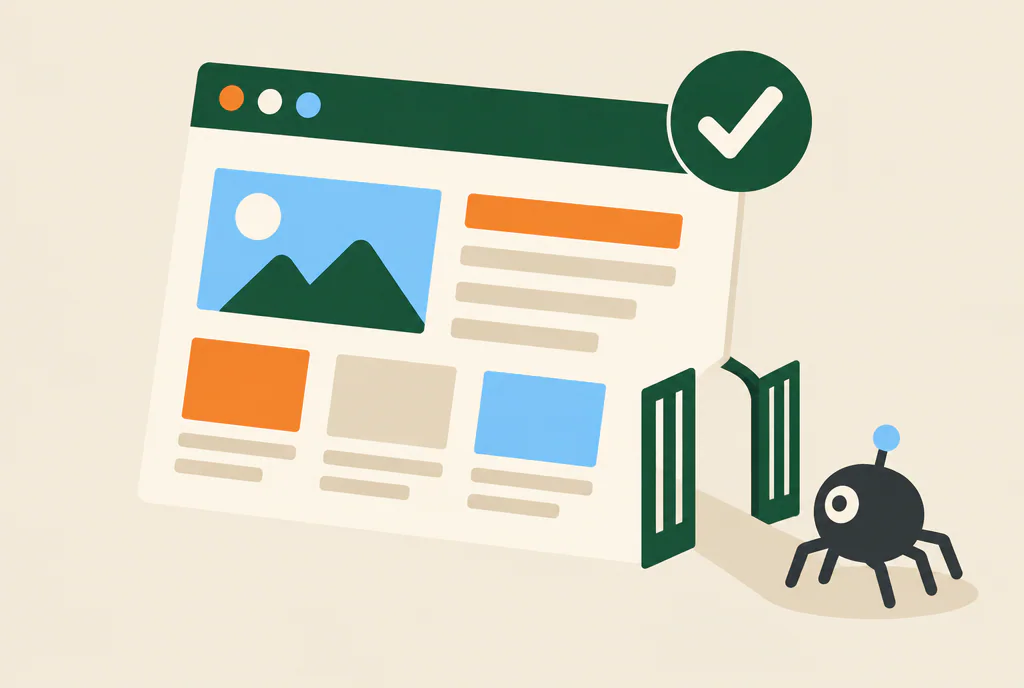
Check that your robots.txt file, the file that tells crawlers which parts of your site to avoid, is not blocking Google or AI search tools. It is a common and easily missed cause of invisibility.
| Requirement | What to check | Where to check it |
|---|---|---|
| Crawlable | robots.txt does not block Google or AI search tools | yoursite.com/robots.txt |
| Indexable | No stray noindex tag, and the page is in Google’s index | Search Console URL Inspection |
| Findable | Internal links point to the page | Your own site navigation and content |
| Page experience | Pages load quickly and work on mobile | Your own device tests and Search Console |
| Structured data | Markup matches visible text | Google’s Rich Results Test |
| Snippet eligibility | No nosnippet or tight max-snippet limits by accident | Page source and HTTP headers |
Preview controls and their trade-offs
Preview controls such as nosnippet and max-snippet let you limit how much of a page Google can show. They give you control, but tight limits can also reduce how your content appears in AI features, so use them on purpose rather than by default.
How do you measure visibility in AI Mode?
Use Google Search Console, where AI feature traffic is reported within overall Search performance, and track clicks, impressions and queries over months. Google’s AI features documentation covers how this traffic is counted.
Be realistic: AI-specific tracking is limited. You won’t get a neat AI Mode report in Search Console, so look at trends instead. Compare your query sets before and after publishing new content, and watch whether impressions and clicks rise for the topics you wrote about.
Give it time. With three to six months as a typical build period, a month-one dip or flat line tells you little. Our results come from your own Google Search Console, not our estimates. We think that is the honest way to judge any SEO work.
How can you keep up with AI Mode without writing everything by hand?
Consistent, researched publishing is the hard part, and tools can automate it while you keep control of what goes live. That is what RankOtter is for.
Every article is researched from the pages already ranking on Google before a word is written. You choose how much control you want, from approving every article to full autopilot. Try it free. Enter your website and we analyse it in about 30 seconds, and your first article is free with no card needed.
RankOtter is built by PS Website Design Ltd, a UK web and app development agency that has built and looked after websites for UK businesses since 2009. We use it on our own clients’ websites. Plans are priced in articles a month, not credits or words. Growth is £99 + VAT a month for 30 articles on one website. You can see the rest on our pricing page.
If you would like to speed up your SEO work, get in touch with Rank Otter and we will happily talk it through.
Frequently asked questions
How do I reach AI Mode in Google?
AI Mode is offered as an option within Google Search, so look for it alongside your search results. Availability can vary by country and account, so check Google’s own help pages if you cannot see it.
How do I find my keyword ranking on Google?
Google Search Console shows the queries your site appears for, with impressions, clicks and average position. Use it to track the same keywords over several months rather than checking a single day.
Do I need special schema to appear in AI Mode?
No. According to Google, there are no special requirements beyond being indexed and eligible for Search. If you use structured data, make sure it matches the visible content on the page.
Can AI-written content rank in AI Mode?
Google’s guidance on generative AI content focuses on quality and usefulness to people, not on how the text was produced. Content that is unique, accurate and genuinely helpful has the best chance.
How long does it take to appear in AI Mode?
SEO typically takes three to six months to build, and AI Mode draws on the same index. Regular publishing over that period matters more than one perfect post.
Should I block AI crawlers in robots.txt?
Only if you have a clear reason to. Blocking AI search tools can keep your pages out of AI answers, so check that your robots.txt is not blocking them by accident.