SEO for landscapers UK: how to get more local enquiries
A practical guide to SEO for landscapers in the UK: Google Business Profile, service pages, reviews, seasonal timing and how to publish content consistently.


SEO for landscapers in the UK means making your business easy to find when homeowners search for landscapers near them. Start with a complete Google Business Profile, build a separate page for each service, collect reviews that name the work, and publish helpful content regularly through the spring peak and beyond.
Optimising a landscaping business’s website and Google Business Profile helps it appear in local searches for patios and garden design as well as maintenance, bringing in enquiries.
At a glance
- “Landscaper near me” is reported at around 8,100 monthly UK searches, with demand peaking from March to May, according to SEO Dons.
- Artificial grass searches are reported to be growing by around 25% a year, also per SEO Dons.
- Typical project values are cited as £5,000 to £50,000+ for residential and £20,000 to £200,000+ for commercial work, according to SEO Dons’ complete guide.
- SEO usually takes three to six months to build, so regular publishing matters more than one perfect post.
- The main steps are Google Business Profile, reviews, service pages, seasonal keywords, directories and technical basics, as set out by Digital Tradies.
What is SEO for landscapers in the UK?
For landscapers, SEO is the work of appearing in Google Search and Google Maps when local people look for landscaping services. It suits a trade built on local enquiries because your buyers nearly always search for someone close to their home.
Typical searches include “landscapers near me”, “garden design Leeds” and “patio installers Harrogate”. Each one shows a person ready to talk to someone about a job.
Map results and website results
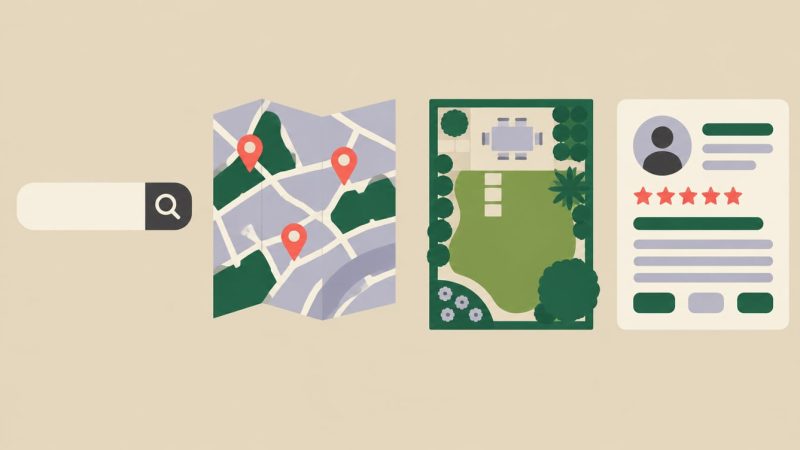
Google shows two main kinds of result for these searches. The map pack is the short list of businesses with a map, drawn mostly from Google Business Profiles. Normal results are the website links below it. You want to appear in both, which means looking after your profile and your website together.
Why organic beats paid over time
Paid ads stop the moment you stop paying. Organic work, such as service pages, reviews and helpful articles, keeps bringing in enquiries once it is in place. That makes the cost of each enquiry tend to fall over time, though it takes patience to get there.
Which keywords should UK landscapers target?
Landscapers should target service plus location searches, split by type of work, because each type attracts a different buyer. Someone wanting weekly lawn care is not the same customer as someone planning a full garden redesign.
| Keyword group | Buyer intent | Example town version | Best page to target |
|---|---|---|---|
| Landscapers near me | Ready to hire locally | Landscapers in Leeds | Home page and Google Business Profile |
| Landscape gardeners | General garden work, often recurring | Landscape gardeners in York | Landscape gardening service page |
| Garden design | Planning a larger project | Garden design Harrogate | Garden design service page |
| Patios | Specific build, higher value | Patio installers Wakefield | Patios service page |
| Artificial grass | Low maintenance upgrade | Artificial grass Leeds | Artificial grass service page |
| Driveways | Specific build, higher value | Driveway installers Bradford | Driveways service page |
| Commercial grounds maintenance | Contract buyers, longer decisions | Grounds maintenance Leeds | Commercial services page |
Keep maintenance apart from big projects
Recurring maintenance and one-off projects need different pages and different wording. The same goes for garden design and landscaping: design buyers want ideas and planning, while landscaping buyers often want the build.
What the numbers say
According to SEO Dons, “landscaper near me” attracts around 8,100 UK searches a month, and artificial grass searches are growing by around 25% a year. These are reported figures, so treat them as a guide and check your own area in Google Search Console.
How do you set up a Google Business Profile for a landscaper?
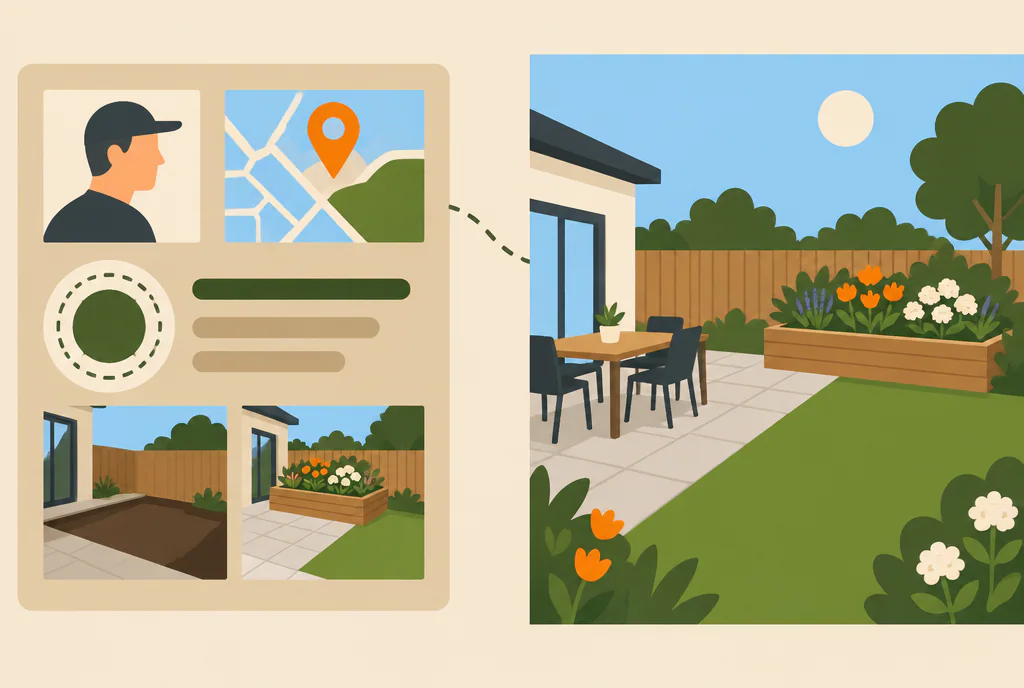
A landscaper should choose the right primary and secondary categories, set a service area instead of a home address, list every service and add real photos. A complete profile gives Google clear signals about what you do and where.
- Categories: pick the one that best describes your main work as primary, then add secondary ones for other services.
- Service area: list the towns you cover and hide your home address if you work from home.
- Services: add each job type, such as patios, fencing or turfing, with a short description.
- Opening hours: keep them accurate, including any seasonal changes.
Real photos beat stock
Real photos and real job stories beat stock content every time. Upload before and after shots from finished jobs, with a line on what you did. Post updates through the year too, such as spring lawn work or autumn clear-ups, so the profile stays active.
How do reviews help landscapers rank?
Regular, genuine reviews that mention the type of work and the town build trust with buyers and support local rankings. A string of reviews naming patios in Leeds tells both people and Google what you are known for.
- Ask after each finished job, while the result is fresh, and send a direct review link.
- Invite customers to mention the work, such as a patio or fencing, though the words must be theirs.
- Reply to every review, good or bad, in a polite and plain way.
- Never fake reviews or pay for them. It breaks Google’s rules and damages trust.
What pages and content does a landscaping website need?
A landscaping website needs one page per service, a small set of genuine area pages, project galleries and blog posts that answer real customer questions. Each page should have one clear job.
Service pages and area pages
Separate service pages matter because the buyers differ. Never publish near-identical pages for different towns, as Google treats them as spam. If you do build area pages, make each one properly local, with real jobs you have done there, local details and photos.
Write about real questions
Write about the questions customers actually ask you, such as how long a patio takes or whether artificial grass drains well. Those answers match real searches and show you know the trade. Digital Tradies also lists directories as part of the basics, so claim listings with the same name, address and phone details everywhere.
Technical basics
- Check your robots.txt file, which tells search tools what they may read, isn’t blocking AI search tools.
- Make sure pages load quickly on mobile.
- Show clear contact details on every page.
- Add schema, a small piece of code that tells search engines what your business is.
When is the best time to do SEO for landscapers?
Demand peaks from March to May, but SEO takes three to six months to build, so the best time to start is autumn or winter. Starting in late November, as now, gives you a fair chance of being ready for spring 2027.
- Winter: plan content, fix your profile and build service pages.
- Early spring: push hardest on patios, garden design and artificial grass.
- Summer: focus on maintenance and finished-job stories.
- Autumn: cover clean-ups and plan the next year.
Publishing regularly matters more than one perfect post. Track enquiries by job type in Google Search Console to see which pages bring in the work, and do the same for paid ads if you run them. Ads give faster leads, while SEO builds slowly and lasts longer, so many landscapers use both.
How can you keep publishing SEO content without the time cost?
Landscapers and the agencies serving them can automate research-led article publishing while keeping control of approval. That keeps the routine going through busy months on site.
Rank Otter researches the pages already ranking on Google before a word is written, then publishes to your website. You choose how much control you want, from approving every article to full autopilot. Plans are priced in articles a month, not credits or words:
- Growth: £99 + VAT a month for 30 articles and 1 website
- Pro: £199 + VAT a month for 75 articles and 3 websites
- Agency: £449 + VAT a month for 200 articles and 10 client websites
Your first article is free with no card needed, and results come from your own Google Search Console, not our estimates. Rank Otter is built by PS Website Design Ltd, a UK web and app agency that has looked after websites for UK businesses since 2009, and we use it on our own clients’ sites. See the trades page or pricing for more, or contact Rank Otter to try your free first article.
Frequently asked questions
How much does SEO cost for a landscaper in the UK?
The cost depends on whether you hire an agency, do it yourself or automate it. With Rank Otter, plans start at £99 + VAT a month for 30 articles and 1 website, and your first article is free.
How long does SEO take to work for landscapers?
SEO usually takes three to six months to build. Regular publishing matters more than one perfect post.
Is SEO better than Google Ads for landscapers?
Neither is better in every case. Ads bring faster leads but stop when the budget does, while SEO builds slowly and keeps bringing enquiries once established.
Do landscapers need a blog?
A blog helps because it lets you answer real customer questions and show real jobs. Regular posts give Google more to rank you for.
How many area pages should a landscaper create?
Create only as many as you can make genuinely local. Near-identical town pages are treated as spam by Google, so a few strong pages beat many copies.
Can I do landscaping SEO myself?
Yes, the basics are within reach: a full Google Business Profile, service pages, reviews and regular posts. The hard part is finding time, which is where automation can help.
Is SEO dead or evolving in 2026?
SEO is evolving rather than dead. Local search and AI search tools still need clear, helpful pages, so check your robots.txt isn’t blocking them and keep publishing useful content.