
What is answer engine optimisation (AEO)? A UK guide
Answer engine optimisation (AEO) is how you get cited by ChatGPT, Gemini and Google AI Overviews. Learn how it differs from SEO and how to start.


Answer engine optimisation (AEO) is the practice of shaping your website content so AI tools can find it, understand it and cite it when people ask questions. These tools include ChatGPT, Google AI Overviews, Gemini and Perplexity. It builds on SEO, but aims to be quoted in the answer rather than only ranked in a list of links.
At a glance
- AEO aims to get your content mentioned, recommended or cited in AI answers on tools such as ChatGPT, Gemini and Perplexity.
- Google AI Overviews appear on roughly 13 to 20 percent of search queries, according to Target Internet.
- Search Engine Journal reports Google’s guidance describes AEO and GEO as “still SEO”.
- SEO typically takes three to six months to build, so regular publishing matters more than one perfect post.
What is answer engine optimisation?
Answer engine optimisation is the work of making your content easy for AI tools like ChatGPT, Google AI Overviews, Gemini and Perplexity to find, understand and quote. Where SEO aims to rank you in a list of links, AEO aims to get you quoted in the answer itself.
Answer engine versus search engine
A traditional search engine gives you a page of links and leaves you to click through and read. An answer engine reads many pages for you, then writes a short reply in plain language. Sometimes it names the sources, sometimes it names businesses, and sometimes it names nobody at all. Your goal is to be one of the names.
The line between the two is blurring. Google now puts AI-written summaries above its normal results, so one search can produce both a list of links and an answer.
A worked example from Leeds
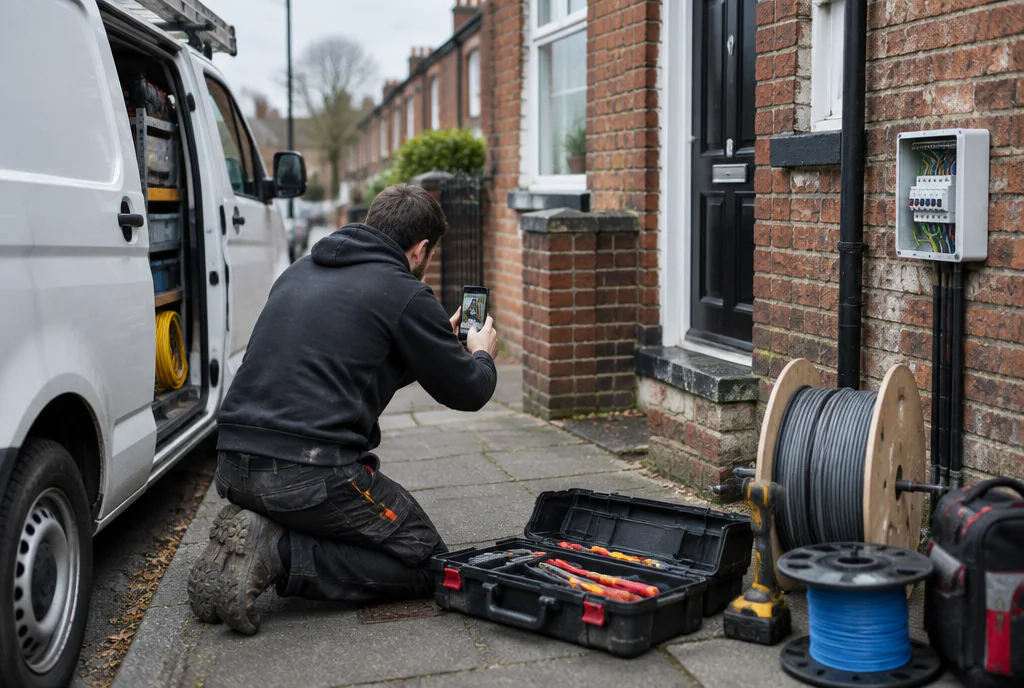
Picture someone in Leeds asking an AI tool, “Which electrician should I call to rewire a Victorian terrace?” The tool pulls together what it can find and offers a few names or a summary of what to look for. An electrician whose site clearly explains rewiring older homes gives that tool something solid to quote. That means real job detail and straight answers to common questions. A site with a thin page saying “we do all electrical work” gives it very little.
GEO, LLMO and other labels
You will see other terms for similar ideas, including generative engine optimisation (GEO) and large language model optimisation (LLMO). They overlap heavily with AEO. Different vendors favour different labels, but the practical work is much the same. Ahrefs has a clear overview of AEO if you want a second view.
How is AEO different from SEO?
AEO and SEO share the same foundations. SEO targets rankings and clicks, while AEO targets citations and mentions inside AI answers.
| SEO | AEO | |
|---|---|---|
| Goal | Rank high and earn clicks | Be cited or mentioned in AI answers |
| What wins | Relevant, trusted pages with good links and technical health | Clear, direct answers from trusted, well-structured pages |
| How success is measured | Rankings, impressions, clicks, enquiries | Citations, brand mentions, referral traffic, enquiries |
| Typical content shape | Full guides and service pages | Question headings, short direct answers, lists and tables |
Where they overlap
Most of the work is shared. Useful content, a healthy site that loads well and can be crawled, and signs that real people with real experience stand behind it all help in both. If your SEO is weak, AEO will not rescue it.
AEO versus GEO
GEO usually refers to optimising for generative AI tools that write answers, which is very close to what AEO means. Some people use GEO for AI-written results and AEO for any answer format, including featured snippets and voice replies. In practice you would do the same things for both. We wouldn’t lose sleep over the label.
Is AEO real or just SEO with a new name?
AEO is real, but it is largely built on SEO fundamentals, and claims about guaranteed AI rankings are hype. Nobody can promise you a place in an AI answer.
What Google says
Search Engine Journal reports that Google’s own AI search guidance calls AEO and GEO “still SEO”. The same qualities that help a page rank also help it get picked up in an AI answer.
What is real
- People do ask AI tools for recommendations and explanations, and those tools do cite sources.
- You can test whether your business or pages appear for the questions your customers ask.
- Content written as clear, direct answers is easier for these tools to use.
What is hype
- Guaranteed placement in ChatGPT or AI Overviews.
- Secret tricks or special code that force an AI tool to quote you.
- Claims that SEO is dead and you need a brand new strategy.
Our advice
Do not buy a separate strategy. Extend good SEO instead: answer real questions, structure pages clearly, keep the site healthy and keep publishing.
Why does answer engine optimisation matter for UK businesses?
AI answers now sit above or in place of many clicks, and the visitors who do arrive from AI tools may be more qualified. That makes being named in the answer worth working towards.
The numbers, with caveats
Target Internet says Google AI Overviews appear on a notable share of search queries. Both are third-party estimates, not our own data, and this space moves quickly, so check the date on any figure before you rely on it. Treat any figures from earlier years as a snapshot rather than today’s picture.
Zero-click behaviour
When an AI answer satisfies someone, they may never click through. That can mean fewer visits even when your content helped write the answer. So judge success by enquiries and calls as well as raw traffic.
The UK angle
Many UK businesses win work through local and service questions: “how much does a boiler service cost in Leeds” or “do I need planning permission for a loft conversion”. People also phrase questions in British English, with words like “solicitor”, “lorry” or “pavement”. Writing in the way your local customers speak, and about the places you actually work, gives AI tools a better match.
How do you optimise for answer engines?
Work through these steps in order. Most are things good SEO already asks for.
- Answer questions first. Put the direct answer in the opening sentences under each question heading, then add detail.
- Structure content clearly. Use short paragraphs, lists and tables that are easy to quote.
- Add schema where it fits. Structured data and FAQ sections help machines understand the page.
- Build trust. Show real experience, real people and real results.
- Allow AI crawlers. Make sure nothing blocks the tools that read your site.
- Measure. Test key questions and check your own data.
Write about what customers actually ask
We tell our customers to write about the questions their customers actually ask them. Think of the calls, emails and quote requests you get every week. Each repeated question is a page waiting to be written. Start there.
Lead with the answer
Under each question heading, give the answer in one or two sentences, then explain. A tool, or a person in a hurry, can lift that opening and be done. The detail below it shows you know your subject.
Make it easy to quote
Keep paragraphs short. Use a list when you have steps, and a table when you are comparing things. Plain words beat clever ones.
Schema and FAQs
Schema markup is code that labels what a page contains, such as an FAQ, a business or an article. Useful as it is, it does not replace clear writing. An FAQ section at the end of a page is a natural fit where people really do ask follow-up questions.
Show real experience
Real photos and real job stories beat stock content every time. A photo of your own finished kitchen and a short account of what went wrong and how you fixed it says more about your experience than any generic paragraph. This lines up with the experience and trust signals Google calls E-E-A-T.
Check robots.txt
Your robots.txt file tells crawlers what they may read. Check it is not blocking AI search tools, because a page they cannot read is a page they cannot cite. Your web developer can review it in a few minutes.
Avoid near-identical town pages
Never publish near-identical pages for different towns. Swapping “Leeds” for “Bradford” on the same text is a shortcut Google treats as spam, and it gives AI tools nothing useful. If you cover several areas, write something genuinely different for each, such as local jobs, local questions and local detail.
Test and track
Ask the main AI tools the questions your customers would ask and note whether you appear. Repeat it monthly. Pair that with Google Search Console for results you can trust.
How long does AEO take and how do you measure it?
Results build over months, like SEO. In our experience SEO typically takes three to six months to build, so publishing regularly matters more than one perfect post.
What to track
- Citations: whether AI answers link to your pages.
- Mentions: whether your business is named for the questions you care about.
- Referral traffic from AI tools in your analytics.
- Impressions and clicks in Google Search Console.
- Enquiries, calls and sales, which matter most.
Be honest about estimates
Many AI visibility tools sample a limited set of questions, and AI answers change from one moment to the next. Treat their scores as a rough guide, not a fact.
Why we rely on Search Console
We prefer results from a client’s own Google Search Console, not our estimates. It shows real impressions and clicks for your own site, and it is the same data Google gives you for free.
How can agencies and small teams keep up with AEO?
Regular, researched, question-led content is the scalable core of AEO, and a good workflow can automate much of it while you keep control. Most teams struggle with the regular part, not the knowledge.
Research before writing
At Rank Otter, every article is researched from the pages already ranking on Google before a word is written. That shows what searchers expect to see and where an answer can be clearer.
Choose your level of control
You can approve every article before it goes live, or run on full autopilot. Our features page explains the options. Pricing is based on articles a month, not credits or words.
Built by a UK web agency
Rank Otter is built by PS Website Design Ltd, a UK web and app development agency that has built and looked after websites for UK businesses since 2009. We use Rank Otter on our own clients’ websites.
Try it first
Enter your website and we analyse it free in about 30 seconds, and your first article is free with no card needed. We make no promises about results, because nobody honestly can. Would you like to see what regular, question-led publishing looks like for your site? Get in touch with Rank Otter and we will show you.
Frequently asked questions
What does AEO stand for?
AEO stands for answer engine optimisation. It means shaping your content so AI tools and search features can find it and use it in their answers.
Is AEO the same as GEO?
They overlap heavily. GEO usually refers to generative engine optimisation, aimed at AI tools that write answers. In practice the steps are much the same.
Does AEO replace SEO?
No. AEO is built on SEO, and Google’s guidance, as reported by Search Engine Journal, describes AEO and GEO as still SEO. Weak SEO will hold AEO back.
How do I get my business mentioned by ChatGPT?
There is no guaranteed method. Publish clear answers to real customer questions, show real experience, keep your site crawlable and keep going for months. Then test the questions your customers ask.
Do I need schema markup for AEO?
It helps machines understand your pages, so adding it where it fits, such as for FAQs, is worthwhile. But schema is not a substitute for clear, useful content.
Can small businesses do AEO themselves?
Yes. Answering your customers’ real questions, using plain structure and adding real photos and job stories are all within reach. The hard part is staying consistent, which is where a regular publishing routine helps.
How do I check whether AI tools can crawl my site?
Open your robots.txt file at yourdomain.co.uk/robots.txt and check it does not block AI search tools. Unsure what the rules mean? Ask your web developer to review it.
How do I learn answer engine optimisation?
Start with good SEO basics, then read clear guides such as those from HubSpot. Practise by testing your own questions in AI tools and checking Search Console.